

I’ve always made fantasy cast lists for my scripts.
Next to making a playlist, it’s one of the most enjoyable parts of writing. It’s also, strangely, useful. A fantasy cast list helps connect the vision in my head to the words on the page. It makes the imaginary film feel a little more solid.
Not because I think Florence Pugh, Tim Roth, Tom Hanks, or whoever else I’ve scribbled in a notebook is sitting by the phone waiting for my call.
Although, frankly, they should keep Tuesdays free.
When you’re writing alone, characters feel like nothing more than a name on a page. But the moment you imagine a real actor in the role, something sharpens. You can understand the energy of the character. Their voice. Their humour. Their sadness. The way they enter a room. The way they might say nothing and still make the scene buzz.
And it’s not always about finding someone who “looks right”. It isn’t a case of writing an action hero and thinking, “Who’s a good action star? Tom Cruise? Glen Powell? The Stath?”
Sometimes it’s about contradiction. Casting against expectation. Putting warmth into a villain. Vulnerability into someone unreachable.
I’ve done this with most of my scripts. Sometimes the imagined actor unlocks the character. The list becomes a private map of the film I’m trying to make.
Recently, I’ve been trawling through some old scripts, and it made me smile at the cast lists I used to make. They’re time capsules. Most of the actors have grown too old for the roles. Some are no longer with us. Some choices make me wince. Some make me think, “Actually, that would have been bloody brilliant.”
Writing has always felt like an extension of playing and pretending - much like six-year-old me arranging Star Wars figures on the carpet and inventing my own version of how to rescue Han Solo from whoever Jabba was supposed to be.
I thought it might be interesting to look back through them, not because they’re important, but because they say something about what I was trying to write at the time. So, I present to you a warts-and-all list, ranging from the cringey early days of starting out to the writer I am now, thirty-odd years later.
30-1
The “hey, we’ve all got to start somewhere” script.
When I first started scriptwriting in the early 1990s (after a single attempt with a friend to rewrite Aliens, but with killer carrots?), one of my first proper attempts at a screenplay was a Die Hard rip-off played mostly for laughs. I was still in my teens, and the script, like many written around that time, was incredibly cringey and naive.
It was also powered entirely by film fanboy excitement.
The plot involved terrorists taking over a shopping mall. Naturally, all the terrorists had to be played by well-recognised bad guy character actors from the 80s and 90s: Vernon Wells, Kurtwood Smith, Clancy Brown, Gary Busey, William Sadler, Brion James, Rutger Hauer, Ray Liotta, Lance Henriksen, Luis Guzmán, Robert Patrick, Robert Englund…
So much for casting against type.
It was essentially fan fiction before I knew such a thing existed. But that list tells me exactly where my head was: VHS shelves, action movies, character actors, and the sheer joy of imagining a film before I had the faintest idea how to write (or even format) one properly.
UNTITLED HEIST… THING
My next, more serious attempt at a screenplay was a heist story.
Well, it was 1992, and Reservoir Dogs was my then-favourite film, so “heist story” is putting it generously. It was basically Reservoir Dogs meets Assault on Precinct 13.
A gang of robbers double-cross a crime boss by pulling off a daring raid he had planned himself. They hide out in an abandoned location to evade the heat, only for masked gunmen to arrive and collect what their boss believes is rightfully his.
Essentially, I wrote the remake of Assault on Precinct 13 thirteen years before it actually happened.
The cast included an array of UK and Irish talent: Gary Oldman, Tim Roth, Danny Webb, Ralph Brown, Phil Daniels, and a post-Millers Crossing/Pre-Usual Suspects Gabriel Byrne. It was a good attempt at a script in a “there, there” pat-on-the-head kind of way.
But who wouldn’t have wanted to see that cast go head-to-head?
This one says a lot about me at the time. I wasn’t yet writing from life. I was writing from other films. I was trying on voices and influences like hand-me-down clothes. Some fitted better than others.
UNTITLED NONSENSE
At one point, I tried to create a script that would have Al Pacino, Robert De Niro, Jack Nicholson, Christopher Walken and Harvey Keitel in a car.
And probably Joe Pesci in the boot.
It was probably called something like Five Guys in a Car, because that’s how basic the idea was. It never got going because it lacked essential things like A BLOODY STORY, but regardless of how much of a non-starter it was, who wouldn’t have paid to see those guys sodding about in a car for a day?
Did I even need to write a script? Just film them and let them improvise the damn thing. Five Easy Pieces Part 2. Done.
Al shouting. De Niro doing that downturned mouth thing and nodding. Walken being weird. Jack being Jack. Keitel probably nude, as was his wont around that time.
Gold dust, I tells ya.
There has always been a part of me that gets nostalgic for the What Ifs. I suspect that’s why so many belated sequels and long-delayed team-ups get made, even when they don’t quite connect, or feel like too little, too late.
They’re chasing the version that should have happened years earlier. The actor pairings we wanted before time, age and expectation got in the way. Pacino and De Niro in Heat? Amazing. About time. Practically a celebration of their talent. Pacino and De Niro in Righteous Kill?
Hmm.
There’s no deep lesson here, except maybe this: sometimes fantasy casting exposes the fact that you don’t actually have a story. You have a poster. A daydream. And Joe Pesci in the boot.
THE WAR OF THE WORLDS
This wasn’t any old War of the Worlds adaptation.
This was Andrew Wright’s H.G. Wells’ The War of the Worlds.
I spent the summer of 1995 reading Wells’ book and listening to the 70s Jeff Wayne rock opera, such was my obsession with the story. I was determined to adapt it as faithfully as I could.
Anthony Hopkins was the astronomer - and heat-ray victim numero uno - who first discovers that the Martians are intending on paying Earth a visit. His slimy posh-boy assistant Stent was played by Hugh Grant, before he’d even dreamt of playing bad.
Gary Oldman was the lead, playing the Journalist we follow throughout the story. Tim Roth was the Artilleryman he chances upon twice: once cowardly, later insane. Stent would eventually reappear as a cult-like leader of underground survivors, whom he sells out to the Martians.
There still hasn’t been a true, decent adaptation of The War of the Worlds. Unless you include Ice Cube’s attempt, which, as we all know, is how Wells would have wanted it.
This fantasy cast was different from the earlier ones. It wasn’t just “wouldn’t it be cool if…” There was reverence in it. I was trying to imagine a proper film. A faithful film. A big, serious adaptation. I was still wildly impractical, obviously, but there was more purpose behind the choices.
US OR THEM
I was - and still am - big on Walter Hill movies, and I wrote a script that was essentially Trespass meets Southern Comfort.
After a raid on a criminal hideout goes wrong, a group of cops are suspended from duty. One of them discovers the real location of the criminals’ hidden loot and tells his friend, who unfortunately can’t keep a secret. Before long, the disgraced cops are hunting down what they consider to be their retirement plan in a rundown factory wasteland.
Only they’re not alone.
The loot is being guarded, and the cops are walking straight into a trap.
This had a very mid-90s cast: Oldman, Roth, Byrne - you may be spotting a trend by now - Ewan McGregor, Tim Spall, Peter Stormare. Pierce Brosnan even shows up and is promptly dispatched, just to keep the audience on their toes.
There are probably signs of life somewhere in this script, but it needs a page-one do-over. In other words: burn the existing screenplay.
The thing is, this was me thirty years ago. I was still obsessed with no-nonsense men with guns in abandoned places. These days, I’m less interested in the explosions and more interested in why everything blew up in the first place.
I always said that if I ever wrote a Die Hard movie, it would be set the day after the terrorist event, with McClane changing his vest and having a lie down.
I should never write a Die Hard script. Ever.
EPIC / CROUCH VALLEY/ HANDSHAKE FROM HELL/ BORDER WORLD Episode One: The Northampton Menace (It was never called this)
In 1998, I wrote a script that had many, many names, but was mainly called Epic. Because it was just that.
Y’know when writers give advice and say, “Don’t write for anyone but yourself”? This was that screenplay. The one where I went: screw it, I’m writing whatever I want.
It was a sci-fi western. A big story in every sense, with a huge cast. I later wrote a prequel called Border World, which I’ll write about properly another day.
Epic was bonkers. Originally 180 pages long, it got me an agent, who first wanted to meet me “to see if you were actually barking mad.” I took that as a compliment.
The script couldn’t find a home. “Only Ridley Scott or Terry Gilliam could make this,” said Peters, Fraser and Dunlop. Fine by me. Get them on the phone. What they actually meant was: “This is too expensive, even for 1998.”
Epic was set in a future where cities exist safely inside domes, keeping the horrors of the outside world at bay. Society is maintained through brutal control and absolute justice. So, yes, it was sort of a play on Judge Dredd, except the story centred on two lowly police officers slowly questioning “the truth” of their world.
These were to be played by Steve Buscemi and Jamie Kennedy, then freshly dispatched from Scream 2. Did I mention it was an action comedy?
Steve and Jamie become unwittingly involved in a secret rebellion led by Famke Janssen, which goes very wrong. They end up on the wrong side of the wall, along with John Turturro’s bullying superior officer.
Out in the real world, with bulletproof armour and militarised hoverbikes, they quickly become targets for anyone who wants their weaponry. Realising Turturro is going to get them killed quicker than anyone else, they leave him for dead and disguise themselves as gunmen-for-hire.
Caught between two warring towns, Steve and Jamie try to play both sides against each other. Their plan goes awry when their ex-employers dispatch a hit squad to eliminate them. Meanwhile, a left-for-dead Turturro is saved by a hillbilly survivalist cult, who become his personal army. Like I said: bonkers.
The script was verrrrry loosely based on The Man Who Would Be King. I still love the idea of two chancers trying to win big, but not having the necessary chutzpah until they’re pushed to the very ends of themselves.
The cast list, however, was ridiculous.
Ving Rhames. Angelina Jolie. Liev Schreiber. Christian Bale. James Earl Jones. Donald Moffat. Brad Dourif. Thomas Waites. David Patrick Kelly. Meat Loaf. Yaphet Kotto. Jim Belushi. Clancy Brown. Harry Dean Stanton. Gene Wilder. Michael Palin. Ray Meagher - yes, Alf from Aussie soap Home and Away - as a no-nonsense shanty town barman.
And that’s not even half the list. It was like I was doing it as some sick bet. Good grief.
But this is the one where I can also see ambition. Mad, mostly uncontrolled ambition, yes, but ambition all the same. I was thinking in worlds. In scale. In a cast of thousands. I had a sense of budget, and I knew it was ridiculous. But, that’s the film I saw in my head, along with several sequels, obviously.
GUNDOWN
What’s this? A game played out in the real world where thirty players have to eliminate each other by gun?
That calls for a big cast.
As the story featured characters from all walks of life, the fantasy cast had to represent hard: Tim Roth - oh, hello again - Mads Mikkelsen, Bob Hoskins, Nicholas Lyndhurst, Christopher Lee, Riz Ahmed, Franka Potente, Dominic West, Ray Stevenson, Mark Heap, Chiwetel Ejiofor, Meredith MacNeill, Stellan Skarsgård, Lucy Cohu, Jamie Bell…
This was a story where you didn’t know who would be the last person standing.
The original image that sparked it was Nicholas Lyndhurst having a shoot-out on a London bus. Which, frankly, still has something.
Gundown was another one built from a very visual idea. A game - and a game cast - pushing themselves beyond expectation. It was still me thinking like a film fan, but there was also something more structured in it: the fun of taking familiar faces and making the audience question who mattered, who would survive, and who might suddenly vanish.
Then I had children, and writing turned another corner…
BACKSTABBERS
Having children - and looking after them full-time - meant I had to adjust my expectations when it came to getting work done. Instead of long, uninterrupted stretches at a desk, I made notes on my phone and fitted in writing when the children were sleeping.
The first screenplay I wrote during this time was the Border World prequel, again as a no-pressure, do-as-you-please effort.
But whenever I took the children for walks in their buggy, there was one story that kept circling in my mind.
Backstabbers was originally written around 1997. I’d just seen Scream and wanted to do my version, but with less gore and more laughs. The script had its moments, but it was what it was - Scream wearing a false moustache and a bobble hat.
Many attempts later, I tried to craft it into something more substantial by working on it as a novel. And by jove, I cracked it.
I then adapted the novel into a television series. Set in 1979, Backstabbers charts the rite of passage of a naive would-be writer who becomes embroiled in a series of deaths that, on the surface, appear to be tragic accidents. It plays on those Public Information adverts designed to terrify children into not playing on farms, messing about near electricity substations, or jamming their fingers into plug sockets.
The community of am-dram actors and wannabe superstars wasn’t drawn from a fantasy casting wish list. Instead, I based each main character on a celebrity from the era. Who did these people model themselves on? Kate Bush? Lewis Collins from The Professionals? Phil Daniels in Quadrophenia?
I plan to do the same for the sequels, which are set in the 1980s and 1990s.
For a visual aide-mémoire, visit here.
NOSTALGIA
This is the fantasy cast I really want. And I’m acutely aware that time is against me on this one.
Nostalgia is a story about revisiting memories. I wrote the main role of emotionally repressed Paul for Colin Farrell, who, blow me down, went and made A Big Bold Beautiful Journey - a film about revisiting memories. Bugger.
Thankfully, it’s nothing like Nostalgia.
In my story, Paul becomes the guinea pig for inventors Roger and Kirk, played in my head by Marc Maron and Brie Larson. Paul learns that his recently deceased father, Ivor - Sam Neill - was the original test subject for the memory machine, and had become addicted to revisiting his own memories, and those of his grown children.
There’s mother-hen Brydie, played by Melanie Lynskey. Recovering alcoholic pub barman Wayne, played by Ben Mendelsohn. Eternal man-baby Elliott, played by Andrew Garfield. And Paul’s ex-fiancée Meredith, played by Cristin Milioti.
Paul believes he can master the machine and control his addiction, but when he trespasses into Meredith’s memories to learn where he went wrong, the battle for truth becomes a fight for survival.
This is where fantasy casting stops feeling like a game and starts feeling painfully specific. These choices aren’t just about who would be cool in the roles. I knew the characters - their emotional wounds, their buried resentments, the parts they play every day just to keep life moving along - and I knew who could land those roles. From my lips to God’s ears.
THE OUTRUNNERS
A dystopian western with a twist: sunlight kills.
Roving clans fight each other for whatever supplies they can get their hands on, until a truce is called by a King-of-the-North type, who seeks to unite everyone in order to stay alive.
The Outrunners - black sheep and reluctant seer Heisel, philosophical Folan, scarred gunslinger Zannah, knifewoman Shinda, and analytical Laurik - are soon running for their lives from a power-hungry warlord bent on unleashing an apocalyptic weapon.
In my head, the young cast includes Dafne Keen, Dominic Sessa, Carla Tous, Amber Midthunder and Josh O’Connor. Also not appearing are Glen Powell as a friendly stranger who comes to the gang’s aid, Tom Hardy as their fallen leader, Dave Bautista as the king-like figure, and Paul Giamatti as an old-timer bounty hunter.
This is me returning to genre, but with a different eye. The younger me would have been most excited by the weapons, the clans, the violence, the world-building. The older me is more interested in the group dynamics. The weariness. The pressure. The way people cling to each other when the world has become impossible.
LUMEN / VERSES
Lumen is a story about the many-worlds theory. It sees Veronika Remick, played in my head by Cynthia Erivo, team up with sceptical-but-needing-the-money science journalist Isabelle Briest, played by Florence Pugh, to find out whether Veronika’s deceased inventor father was a genius or a madman.
Veronika is an emotionally scarred survivor. Briest wavers between pity and extreme caution.
When I wrote the sort-of-sequel, Verses, rather than repeat the original, I explored an alternate reality instead. Veronika became Remik, played by FKA Twigs - a global megastar - while Briest became Issy, played by Mia Threapleton, a socially awkward, failing writer.
This is where casting becomes a way of showing the same souls on completely different journeys. Who they might have been in another life. How different choices, different worlds, and different wounds might reshape them.
And maybe, in some lives, certain souls are destined to find each other.
PERFECT HARMONY
Ah, my A24 movie.
Perfect Harmony is about social climber Robin, played in my head by Jenna Ortega, who enlists the help of her jet-set friends - party girl Melina, sensible Polly, dull fiancé Edgar and outsider influencer Amon - to transform a brutalist shell of a mansion into her dream home.
Which turns out to be a cinch. All the house needs is… blood.
Sophie Thatcher, Ella Purnell and Dominic Sessa all appear in my imaginary version. Austin Butler plays Robin’s ex-boyfriend, car mechanic Jonas, while Hugh Grant cameos as a Cary Grant-esque private investigator.
Yes please, film God.
This one is about tone. The cast has to sell the glitz ‘n glamour, the absurdity, the horror, and the comedy of people who think they can buy their way into perfection, only to discover the house has other ideas.
THE MUTUAL
My most recent effort was written with a much clearer eye for casting.
Kristen Wiig as Kitty, a woman realising she is completely friendless and trying to discover why. Her ex-work colleague Zelda, played by Zrinka Cvitešić, contacts her because Kitty is an online “mutual” - and, more importantly, friends with Christine, played by Hannah Waddingham - the woman Zelda suspects of murder.
Tim Roth does not appear as Scandi-noir novelist Compton.
Rachel Weisz and Rose Byrne do not appear as Kitty’s ex-friends, life-and-soul-of-the-party Fiz and Edwina, who once promised Kitty they would all grow old together as friends. (Hint: She lied.)
These days, fantasy casting feels different to me. Less “wouldn’t they be great in this?” and more “yes, that’s her.” The Mutual needs people who can play loneliness, suspicion, old friendship, disappointment and comic panic. It’s about women over fifty dealing not only with a possible murder, but with the quieter mystery of how their own lives ended up this way. In my head, these actors get them.
Call Me, Obviously
So, all of this isn’t really about famous-actor wish fulfilment. Well, not entirely.
It’s about trying to explain the movie in my head before it exists anywhere else. A fantasy cast list can be a writing tool, a mood board, a map, a prayer, or a record of who you were when you still thought Gary Oldman and Tim Roth needed to appear in absolutely everything.
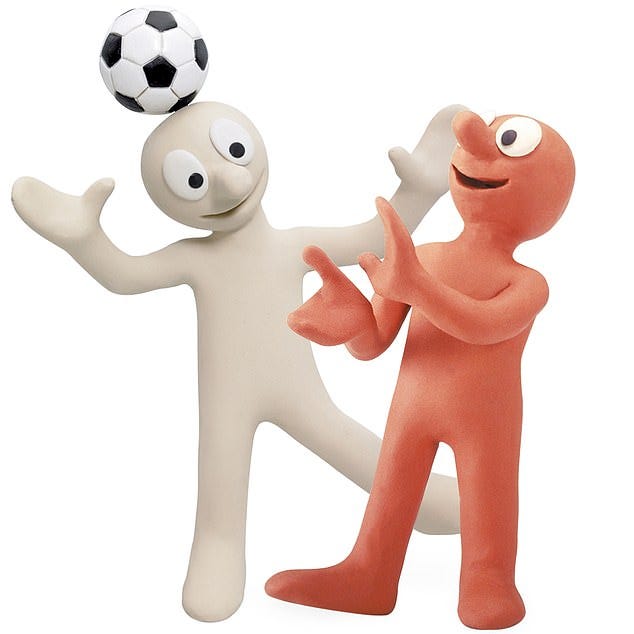
Fingers crossed for that live-action reimagining of the UK children’s classic Morph, featuring Oldman and Roth as the plasticine legends in latex onesies.
Looking back at these old lists, I can see the writer I used to be. The fanboy. The genre obsessive. The shameless borrower. Talent borrows, genius steals, right? RIGHT? The one who overreached, but knew exactly how the film should feel.
And I can see the writer I am now. Still making lists, but with a bit more focus. A bit more attention to who the characters really are.
Also, obviously, if any of these actors are reading: call me. Especially Tim and Gary. Morph: The Movie could be the bold late-career definer/left turn you didn’t know you needed.
🎞️ Follow me on Letterboxd